4 Synthetic Extensions
For any map \(f:X\rightarrow Y\) of synthetic spectra, we have the induced morphism of converging spectral sequences. The resulting extension spectral sequence is denoted by the ESS of \(f\).
4.1 Lambda extensions
There are certain special maps between synthetic spectra that we want to consider. For any \(n{\lt}m\le \infty \) and a spectrum \(X\), we have the following distinguished triangles of \(\mathrm{H}{\mathbb F}_2\)-synthetic spectra
We simply write \(\rho =\rho _{n,m}\), \(\delta =\delta _{n,m}\) by abuse of notation if \(n,m\) is understood in the context. When \(m=\infty \), this sequence is interpreted as
The only nonzero differentials in the extension spectral sequences for the maps \(\lambda ^n\) and \(\rho \) from Notation 4.1 are the \(d_0\)’s:
As a result, these \(d_0\)’s have no crossings.
First, we show that the the following sequence is exact in the middle:
We apply Proposition 0.121 and prove this case by case.
When \(t-w{\lt}0\) or \(t-w\ge m\), the middle group \(E_\infty ^{s,t,w}(\nu X/\lambda ^{m}) = 0\), so the sequence is exact in the middle.
When \(0\le t-w{\lt}n\), the sequence is isomorphic to
which is exact in the middle because the second map is clearly injective.
When \(n\le t-w{\lt}m\), the sequence is isomorphic to
which is exact in the middle because the first map is clearly surjective.
Thus, we have shown that (4.1) is always exact in the middle. Combined with Corollary 0.56 we conclude that all \(d^{\lambda ^n}_i\), \(d^{\rho }_i\) are trivial for \(i{\gt}0\).
From the proof above, we see that in (4.1), \(\lambda ^n\) is surjective or trivial, while \(\rho \) is injective or trivial.
4.2 Delta extensions
However, the \(\delta \)-extension spectral sequence for
is more complicated, as it encodes classical Adams differentials \(d_2\) through \(d_m\).
For the convenience of readers to check gradings, whenever we write
for \(f: \Sigma ^{m,w} \nu X\to \nu Y\), \(x\in E_\infty ^{s_1,t_1,w_1}(\nu X)\) and \(y\in E_\infty ^{s_2,t_2,w_2}(\nu Y)\), the following conditions must hold:
Suppose in the classical Adams spectral sequence of \(X\) we have \(d_r(x)=y\), where \(x\in Z_{r-1}^{s,t}(X)\) and \(y\in Z_\infty ^{s+r,t+r-1}(X)\). Consider the map
If \(r\ge n+1\), then we view \(x\) as an element of
\[ E_\infty ^{s,t,t}(\nu X/\lambda ^n)\cong Z_n^{s,t}(X), \]and \(\lambda ^{r-n-1} y\) as an element of
\[ E_\infty ^{s+r,t+r-1, t+n}(\nu X/\lambda ^{m-n})\cong Z_{m-r+1}^{s+r,t+r-1}(X)/B_{r-n}^{s+r,t+r-1}(X). \]We then have
\[ d^{\delta }_r(x)=\lambda ^{r-n-1}y, \]which is trivial if \(r{\gt}m\).
If \(r{\lt}n+1\), then we view \(\lambda ^{n+1-r}x\) as an element of
\[ E_\infty ^{s,t,t-n-1+r}(\nu X/\lambda ^n)\cong Z^{s,t}_{r-1}(X)/B^{s,t}_{n+2-r}(X), \]and \(y\) as an element of
\[ E_\infty ^{s+r,t+r-1, t+r-1}(\nu X)\cong Z_\infty ^{s+r,t+r-1}(X). \]In this case, we have
\[ d^{\delta }_r(\lambda ^{n+1-r}x)=y. \]
Since \(\delta =\delta _{n,m}\) is the composition of \(\rho \) and \(\delta _{n,\infty }\) as the following
it suffices to prove the case when \(m=\infty \) by Corollary 0.55. In the rest of the proof we will write \(\delta _n=\delta _{n,\infty }\).
First, we prove by induction on \(n\) that
when \(r\ge n+1\), and
when \(r\le n+1\). (These two expressions coincide when \(r=n+1\).) For \(n=1\), the claim holds since the \(\tau \)-Bockstein spectral sequence is isomorphic to the classical Adams spectral sequence. Now, assume \(n\ge 2\) and the claim holds for \(n-1\).
Consider the following commutative diagram.
By Corollary 0.54, if \(r\le n\), we have
If \(r\ge n+1\), \(x\) can be viewed as an element of the \(E_\infty \)-pages of \(\nu X/\lambda ^{n-1}\) or \(\nu X/\lambda ^n\). We then have
which implies
since \(r-n+1\le r-1\) and hence the indeterminacy \(B_{r-n+1}\) introduced by dividing \(\lambda \) is contained in \(B_{r-1}\). The induction for (4.2) and (4.3) is now complete.
We will show that \(B_{r-1}^{s+r,t+r-1}(X)\) in both equations are actually equal to the sum of images of \(d^{\delta _{n}}_0\) through \(d^{\delta _{n}}_{r-1}\). Consider any \(y'\in B_{r-1}^{s+r,t+r-1}(X)\) and assume that \(d_{r'}x'=y'\) is an essential classical Adams differential for \(2\le r'\le r-1\). If \(r\ge n+1\), using (4.2), we have
and if \(r\leq r'+1\), using (4.3), we have
Notice that the extra indeterminacy here is \(B_{r'-1}\) instead of \(B_{r-1}\). By induction on \(r\), this shows that \(B_{r-1}^{s+r,t+r-1}(X)\) equals the sum of images of \(d^{\delta _{n}}_0\) through \(d^{\delta _{n}}_{r-1}\).
Therefore, we can omit \(B_{r-1}^{s+r,t+r-1}(X)\) and simply write
when \(r\ge n+1\), and
when \(r\le n+1\).
4.3 Delta ESS and Adams differentials
For \(x,y,\delta \) in Proposition 4.5 we always have
if \(0\le a\le n\) and \(0\le a+r-n-1{\lt}m-n\) (the differential is trivial if \(a\) exceeds this range).
As indicated in the proof, the right-hand side of equation (4.4) (considered as a subset of \(Z_\infty ^{s+r,t+r-1}(X)\)) is a coset of
which is the same as the value of the classical Adams differential \(d_r(x)=y\). This implies that the equation (4.4) holds and is essential if and only if \(d_r(x)=y\) holds and is essential. Therefore the \(\delta \)-ESS encodes the same information as the classical Adams spectral sequence.
4.4 Crossings on the \(E_r\)-page
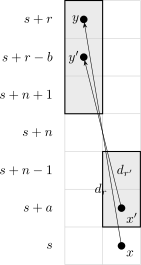
Suppose \(r\ge n+1\) and \(d_r(x)=y\), where
A crossing of \(d_r(x)=y\) on the \(E_{n+1}\)-page refers to an essential Adams differential
where
with \(0{\lt}a\le n-1\) and \(0\le b\le r-n-1\). See Figure 1.
The crossing defined here is opposite to crossings in Moss’s theorem.
4.5 Comparison of crossings
The emphasis on a crossing occurring “on the \(E_{n+1}\)-page" in Definition 4.9 may seem counter-intuitive. However, this is clarified in Proposition 4.11 and Example ?? that follow.
The Adams differential \(d_r(x)=y\) has a crossing on the \(E_{n+1}\)-page if and only if the corresponding \(\delta _n\)-extension
for
has a crossing.
By Propositions 0.121, 0.122 and 4.5, a crossing of \(d^{\delta _n}_r(x)=\lambda ^{r-n-1}y\) takes the form
where \(0{\lt}a\le n-1\), \(0\le b\le r-n-1\),
and
By Corollary 4.7, we see that this crossing corresponds to the classical Adams differential
When \(d_r^{\delta _n}(x) = \lambda ^{r-n-1}y\) has no crossing, then \(d_r^{\delta _n}(\lambda ^a x) = \lambda ^{a+r-n-1}y\) also has no crossing.