6 The Generalized Leibniz Rule and Generalized Mahowald Trick
Now, we introduce the theorem of the Generalized Leibniz Rule, a valuable tool for computing new Adams differentials.
Let \(f: X\to Y\) be a map between two classical spectra. Suppose that \(2\le n\le r\), \(e(f)\le m\le n-2+e(f)\), \(l\ge e(f)\), and we have
and the following conditions hold:
\(d_{r}(x)=x_\infty \),
\(d_{m}^{f,E_n}(x)=y\),
\(d_{l}^{f,E_\infty }(x_\infty )=y_\infty \),
the differential in (1) has no crossing on the \(E_n\)-page or (2) has no crossing.
the differential in (3) has no crossing.
Then we have an Adams differential
Consider the commutative diagram of synthetic spectra
By condition (1) and Proposition 4.5, we have
By conditions (2) and (3), and Definition 5.2, we have
and
which implies
Applying Proposition 4.11 and Proposition 5.7 to conditions (4) and (5), we know that the differential in (6.1) or (6.2) has no crossing, and that the differential in (6.3) has no crossing.
Therefore, we can apply Corollary 0.53 and obtain
By Remark 4.8, this is equivalent to
Let \(f: X\to Y\) be a map between two classical spectra. Suppose that \(2\le n\le r\), \(e(f)\le m\le n-2+e(f)\), \(l\ge e(f)\), \(k\ge 0\), and we have
and the following conditions hold:
\(d_{r}(x)=x_\infty \),
\(d_{m}^{f,E_n, k}(x)=y\),
\(d_{l}^{f,E_\infty , k}(x_\infty )=y_\infty \),
the differential in (1) has no crossing on the \(E_n\)-page or (2) has no crossing.
the differential in (3) has no crossing.
Then we have an Adams differential
Consider the commutative diagram of synthetic spectra
By condition (1) and Proposition 4.5, we have
By conditions (2) and (3), and Definition 5.4, we have
and
which implies
Applying Proposition 4.11 and Proposition 5.11 to conditions (4) and (5), we know that the differential in (6.4) or (6.5) has no crossing, and that the differential in (6.6) has no crossing.
Therefore, we can apply Corollary 0.53 and obtain
By Remark 4.8, this is equivalent to
Let \(f: X\to Y\) be a map between two classical spectra. Suppose that \(2\le n\le r\), \(e(f)\le m\le n-2+e(f)\), \(l\ge e(f)\), \(k\ge 0\), and we have
and the following conditions hold:
\(d_{r}(x)=x_\infty \),
\(d_{m}^{f,E_n, k}(x)=y\),
\(d_{r+l-m}(y)= y_\infty \),
the differential in (1) has no crossing on the \(E_n\)-page or (2) has no crossing,
the differential in (3) has no crossing.
Then we have an \((f,E_\infty )\)-extension
Consider the commutative diagram of synthetic spectra
By condition (1) and Proposition 4.5, we have
By condition (2) and Definition 5.4, we have
By condition (3) and Remark 4.8, we have
Applying Proposition 4.11 and Proposition 5.11 to conditions (4) and (5), we know that the differential in (6.7) or (6.8) has no crossing, and that the differential in (6.9) has no crossing.
Therefore, we can apply Corollary 0.53 to the transposed commutative diagram (with \(\delta _X\) as the first map, \(\hat f_{n-1}\) as the second map, and \(\delta _Y\) as the known target extension) and obtain
By definition, this is equivalent to
We emphasize that the no-crossing conditions in Theorem 6.1, the Generalized Leibniz Rule, are crucial. Without the no-crossing condition, the conclusion could be false.
A version of the Generalized Leibniz Rule without the no-crossing conditions is presented in the synthetic setting in Chua’s work [ . However, there is no doubt that this version is incorrect. For further details, see Remark 6.7.
The essential \((f, E_\infty )\)-extension:
is a crossing for both the \((f, E_\infty )\)-extension,
and the inessential \((f, E_\infty )\)-extension:
This indicates that if we were to disregard the no-crossing condition (5), and apply the Generalized Leibniz Rule to these two cases of the \((f, E_\infty )\)-extensions, we would arrive at two conflicting classical statements:
In Chua’s work [ , it is stated that for a synthetic map \(\alpha : X\rightarrow Y\), and an element \(x \in \pi _{*,*}X/\lambda \), there exists a differential from a maximal \(\alpha \)-extension of \(x\) to a maximal \(\alpha \)-extension of \(d_r(x)\). According to [ , a maximal \(\alpha \)-extension of \(x'\) is defined as \(\alpha [x']\), where \([x']\) represents a lift of \(x'\) to the \(E_{r'}\)-page, chosen such that \(\alpha [x']\) is the most \(\lambda \)-divisible among all such lifts.
In the context of the counter-example above, let \(r=2, r'=\infty \),
and consider \(x = h_4\) in Ext, with \(x' = d_2(x) = h_0h_3^2\).
The \((f, E_\infty )\)-extension:
is equivalent to the existence of a synthetic homotopy class \([h_0 h_3^2]\) in \(\pi _{14, 17} S^{0,0}\), such that
Similarly, the inessential \((f, E_\infty )\)-extension:
implies the existence of another synthetic homotopy class \([h_0 h_3^2]\) in \(\pi _{14, 17} S^{0,0}\), such that
Between these two lifts of \(h_0h_3^2\), the first \([h_0h_3^2]\) is clearly the maximal \([h_0]\)-extension according to Chua’s definition [ . Consequently, the incorrect version of the Generalized Leibniz Rule in [ , would lead to an incorrect conclusion:
Next, we discuss the Generalized Mahowald Trick.
In order to apply the Generalized Leibniz Rule, we need to provide a method for computing extensions on specific Adams \(E_k\)-pages. This is provided by Theorem 6.9 (the Generalized Mahowald Trick). The crux of the proof of the Generalized Mahowald Trick lies in the following lemma.
Let \(X\to Y\to Z\to \Sigma X\) and \(X'\to Y'\to Z'\to \Sigma X'\) be distinguished triangles of (synthetic) spectra. By smashing these distinguished triangles together, we obtain the following commutative diagram of cofiber sequences:
If \(a\in \pi _n(X\wedge Z')\) and \(b\in \pi _n(Y\wedge Y')\) map to the same element in \(\pi _n(Y\wedge Z')\), then there exists \(c\in \pi _n(Z\wedge X')\) such that
\(b\) and \(c\) map to the same element in \(\pi _n(Z\wedge Y')\), and
\(a\) and \(c\) map to the same element via boundary maps in \(\pi _{n-1}(X\wedge X')\).
The proof follows directly from [ .
In fact, consider \(V\) in Axiom TC3 of [ and the corresponding commutative diagram. By [ we know that \(V\) is the pull back of the following diagram.
where the square is a pullback. Since \(a\) and \(b\) map to the same element in \(\pi _n(Y\wedge Z')\), we know that we can find \(v\in V\) such that \(v\) maps to \(a\) in \(\pi _n(X\wedge Z')\) and \(b\) in \(\pi _n(Y\wedge Y')\). Then we let \(c=j_3(v)\in \pi _n(Z\wedge X')\), where \(j_3: V \rightarrow Z \wedge X'\) is the map in the commutative diagram in Axiom TC3 of [ . This lemma follows from the commutativity of the diagram.
Consider a distinguished triangle of spectra
with \(e(f)+e(g)+e(h)=1\). Suppose that \(r=n+m+l\), \(n_1=n-e(f)\ge 1\), \(m_1=m-e(g)\ge 0\), \(l_1=l-e(h)\ge 0\), and
such that
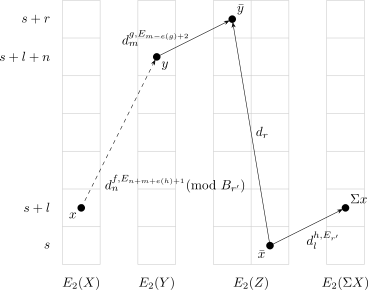
\(d^{h,E_{r'}}_{l}\bar x=x\), where \(r'=r-m_1=n_1+l_1+1\),
\(d_r \bar x=\bar y\),
the \((h,E_{r'})\)-extension in (1) has no crossing, or the Adams differential (2) has no crossing on the \(E_{r'}\)-page,
\(d^{g,E_{m_1+2}}_{m}y=\bar y\),
for \(0 \le i \le n-1\), the Adams \(E_\infty \)-page of \(Y\) vanishes at the positions that are potential targets of \((f,E_r)\)-extensions of degree \(i\) from \(x\): \(E_\infty ^{s+l+i, t+l+i-1}(Y) = 0\).
Then we have \(x\in Z_{n+m+e(h)}^{s+l,t+l-1}(X)\) and
(See Figure 4.)
Consider the following two distinguished triangles of synthetic spectra
and their smash product. See Figure 5.
By condition (1), we have
where \(\hat h_{r'-1}\) is the map \(\Sigma ^{0,e(h)}\nu Z/\lambda ^{r'-1}\to \nu X/\lambda ^{r'-1}\) induced by \(\hat h\). By condition (2), we have
Applying Proposition 4.11 and Proposition 5.7 to condition (3), we know that the differential in (6.10) or the differential in (6.11) has no crossing. Hence, there exists
such that
and
By condition (4), we have
This implies that there exists
such that
where \(\hat g_{m_1+1}\) is the map \(\Sigma ^{0,e(g)}\nu Y/\lambda ^{m_1+1}\to \nu Z/\lambda ^{m_1+1}\) induced by \(\hat g\).
Due to degree reasons (Proposition 0.122), \(\lambda ^{m_1}\bar y\) detects a unique element in homotopy,
Therefore, we have
By Lemma 6.8, there exists
such that
where \(\rho \) is the map \(\nu X/\lambda ^r\to \nu X/\lambda ^{r'-1}\), and \(\hat f_r\) is the map \(\Sigma ^{0,e(f)}\nu X/\lambda ^r\to \nu Y/\lambda ^r\) induced by \(\hat f\).
The equality in (6.12) indicates that \([\lambda ^{l_1}x]\) can be lifted to the \(E_\infty \)-page of \(\nu X/\lambda ^r\), so we have
The equation in (6.13) indicates that
Therefore, by dividing \(\lambda ^{l_1}\), we have
for \(x\) in the \(E_\infty \) page of \(\nu X/\lambda ^{r-l_1}=\nu X/\lambda ^{n+m+e(h)}\). By definition, this is equivalent to
There is also a version of the Generalized Mahowald Trick where the assumptions involve \((g, E_{m_1+2})\)-extensions and \((h, E_{r'})\)-extensions of level \(k\). We leave this generalization to the reader.
We refer to Theorem 6.9 as the Generalized Mahowald Trick, as this approach was first utilized by Mahowald and his collaborators in various works (see, for example, [ ), particularly in the case where \(m_1 = l_1 = 0\). The synthetic setting advances this method by allowing for the consideration of cases where \(m_1{\gt}0, l_1{\gt}0\) as well.
Several versions of classical generalizations of Mahowald’s original trick appear in the literature and are often referred to as geometric boundary theorems. Notable examples include the works of Behrens [ , and Ma [ .
A synthetic generalization of the Mahowald Trick, again lacking any no-crossing conditions, is also presented in Chua’s work [ . This version is also incorrect for similar reasons.
The outcome of the Generalized Mahowald Trick, as stated in Theorem 6.9, is an \(f\)-extension on a specific Adams page. In practice, the source of an \((f, E_r)\)-extension may survive to later Adams pages, prompting interest in the \((f, E_{{\gt}r})\)-extensions. The following Propositions 6.13 and 6.14 describe the relationships between extensions across different pages.
Suppose that we have an \((f,E_r)\)-extension \(d^{f,E_r}_n(x)=y\), where \(x\in Z_{r-1}^{s,t}(X)\) and \(y\in Z_{r-1-n+e(f)}^{s+n,t+n}(Y)\). Then for all \(2\le r'{\lt}r\), we also have
Furthermore, if \(d^{f,E_r}_n(x)=y\) is essential and \(n\le r'-2+e(f)\), then (6.14) is inessential if and only if there exists some \(0{\lt}a'\le n-e(f)\) and an element
such that
for some \(b\ge 0\).
Consider the following commutative diagram:
By Corollary 0.57, \((\rho _X,\rho _Y)\) induces a map from the \(\hat f_{r-1}\)-ESS to the \(\hat f_{r'-1}\)-ESS. Therefore, by naturality,
which, by definition, is
Next, we prove the second part of the proposition. By Definition 5.2, the \((f,E_r)\)-extension (6.14) is inessential if and only if there exists \(0{\lt}a\le n-e(f)\) and
such that
and this differential is not induced by \((\rho _X,\rho _Y)\), as we assume that \(d^{f,E_r}_n(x)=y\) is essential.
There are two scenarios where this differential is not induced by \((\rho _X,\rho _Y)\). The first case occurs when \(\lambda ^ax'\) is not in the image of \(\rho _X\) at all, which is equivalent to \(x'\notin Z_{r-1-a}^{s+a,t+a}(X)\). (See Figure 6.)
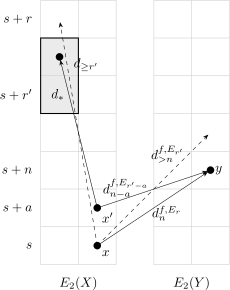
The second case occurs when \(\lambda ^ax'\) is in the image of \(\rho _X\), but it supports an essential \(\hat f_{r-1}\)-extension that is strictly shorter than the differential (6.15).
To further explore this scenario, we replace \(x\) with \(\lambda ^ax'\) and analyze successive essential extensions. This process is repeated iteratively until the first case is reached. Ultimately, this leads to the existence of some \(0{\lt}a'\le n-e(f)\) and an element
such that
for some \(b{\gt}0\). This represents a crossing of \(d^{\hat f_{r'-1}}_n(x)=\lambda ^{n-e(f)}y\).
The following Corollary 6.14 is the contrapositive statement of the second part of Proposition 6.13.
Suppose \(r\ge r'\) and there exists an \((f,E_{r'})\)-extension
for \(x\in Z_{r-1}^{s,t}(X)\) and \(y\in Z_{r'-1-n+e(f)}^{s+n,t+n}(Y)\). Assume that this extension has no crossing of the form \(d^{f,E_{r'-a}}_{n-a-b}(x')=y'\) for any \(b{\gt}0\), \(0{\lt}a\le n-e(f)\), and
Under these conditions, we also have an \((f,E_{r})\)-extension
In Example ??, we use the Generalized Mahowald Trick to establish the \((f, E_3)\)-extension:
for the map \(f=\nu :S^3 \rightarrow S^0\), as discussed in Example ??(2). However, to apply the Generalized Leibniz Rule in proving the classical Adams differential
in Example ??, we need the \(E_\infty \)-page version of the \((f, E_3)\)-extension:
We apply Corollary 6.14 to confirm this.
As checked in Example ??(2), the \((f, E_3)\)-extension has no crossing. Consequently, by Corollary 6.14, we obtain the required \((f, E_\infty )\)-extension: