7 Proof of the main theorem
In this section, we present the proof of our main Theorem 7.1.
The element \(h_6^2\) survives to the \(E_\infty \)-page in the Adams spectral sequence.
We first recall the following theorem, known as the inductive method, originally by Barratt–Jones–Mahowald [ and later extended to the H\(\mathbb {F}_2\)-synthetic setting by Burklund–Xu [ .
Let \(\theta _5 = [h_5^2]\) represent any synthetic homotopy class in \(\pi _{62,62+2}S^{0,0}\) detected by \(h_5^2\) in the Adams \(E_2\)-page. For convenience, we use the same notation, \(\theta _5\), to denote its image in \(\pi _{62,62+2}S^{0,0}/\lambda ^r\) via the map \(S^{0,0} \rightarrow S^{0,0}/\lambda ^r\) for all \(r \ge 1\). Similarly, let \(\eta = [h_1] \in \pi _{1,1+1}S^{0,0}\).
The element \(h_6^2\) survives to the \(E_{r+3}\)-page of the classical Adams spectral sequence if and only if for some \(\theta _5\),
\[ \lambda \eta \theta _5^2 = 0 \ \text{in} \ \pi _{125,125+4} S^{0,0}/\lambda ^{r+1}. \]In particular, \(h_6^2\) is a permanent cycle in the classical Adams spectral sequence if and only if for some \(\theta _5\),
\[ \lambda \eta \theta _5^2 = 0 \ \text{in} \ \pi _{125,125+4} S^{0,0}. \]
The statement in Axiom 7.3(1) was originally stated as
in [ . Upon inspection, \(\pi _{125,125+5} S^{0,0}\) doesn’t contain any \(\lambda \)-torsion classes, so this is equivalent to the version we stated, which is more consistent with the statement in part (2).
Axiom 7.3 is proved using the quadratic construction on a map from the mod 2 Moore spectrum to the sphere spectrum, where the restriction on the bottom cell is \(\theta _5\). Therefore, it is necessary to use a \(\theta _5\) of order 2.
Notably, [ confirms that all classical \(\theta _5\)’s indeed have order 2. Furthermore, from Proposition 0.121 and an analysis of the differentials in the classical Adams spectral sequence, we find that \(\pi _{62,62+2}S^{0,0}\) doesn’t contain any \(\lambda \)-torsion. Consequently, all synthetic \(\theta _5\)’s also have order 2, making it valid to apply Axiom 7.3 to any \(\theta _5\).
Additionally, since the proof of Axiom 7.3 shows that the expression \(\lambda \eta \theta _5^2\) corresponds to the total differential \(\delta _1: S^{0,0}/\lambda \rightarrow S^{1,-1}\) on \(h_6^2\), the value of the expression \(\lambda \eta \theta _5^2\) is consistent for every choice of \(\theta _5\). (Note that our grading for the triangulation translation functor is smashing with \(S^{1,0}\), which is consistent with [ but is different from [ , so the target of \(\delta _1\) is \(S^{1,-1}\). )
We pay special attention to the following three elements on the classical Adams \(E_2\)-page (see Figure 7 and Tables 7, 9, 5, 6 in the Appendix):
For the right side of Figure 7, we use dashed differentials to indicate the shortest possible nonzero differentials that these elements could support.
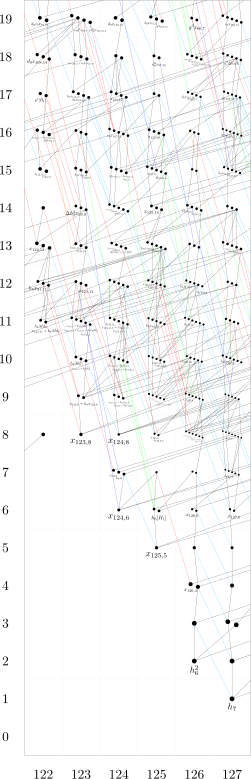
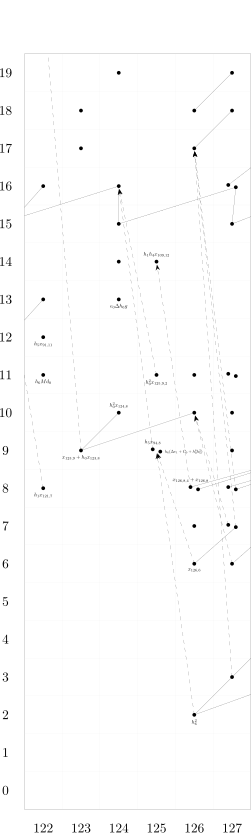
From Figure 7 and Tables 5, 9, 7, 6 in the Appendix, we know that
\(x_{126,8,4} + x_{126,8}\) survives to the \(E_6\)-page.
\(h_1h_4x_{109,12}\) is a permanent cycle, and can only be killed by
\[ d_6(x_{126,8,4} + x_{126,8}) \ \text{or} \ d_{12}(h_6^2). \]\(h_0^2x_{124,8}\) survives to the \(E_\infty \)-page.
In \(\mathrm{Ext}_A^{25,125+25}\), the element \(g^4\Delta h_1g\) is the only one that survives to the classical \(E_5\)-page.
From Table 9 in the Appendix, we have
Therefore, the element \(x_{126,6} \in \mathrm{Ext}_A^{6, 126+6}\) cannot kill \(h_1h_4x_{109,12}\).
We will apply Axiom 7.3 to prove the following Proposition 7.8.
Exactly one of the following two statements is true:
The element \(h_6^2\) survives to the \(E_\infty \)-page.
There is a nonzero classical Adams differential
\[ d_{12}(h_6^2) = h_1h_4x_{109,12}. \]
Furthermore, statement \((2)\) is true if and only if the following three statements are all true:
-
\[ d_6(x_{126,8,4} + x_{126,8}) = 0. \]
There exists a \(\theta _5\) such that \(\theta _5^2\) is detected by \(\lambda ^6 h_0^2x_{124,8}\). In particular,
\[ \theta _5^2 = \lambda ^6 [h_0^2x_{124,8}] \neq 0 \in \pi _{124,124+4}S^{0,0} \]for some \([h_0^2x_{124,8}]\).
There exists a homotopy class \([h_0^2x_{124,8}]\) such that \(\lambda ^3 \eta [h_0^2x_{124,8}]\) is detected by \(\lambda ^6 h_1h_4x_{109,12}\). In particular, we have
\[ \lambda ^3 \eta [h_0^2x_{124,8}] = \lambda ^6 [h_1h_4x_{109,12}] \in \pi _{125,125+8} S^{0,0} \]for some \([h_1h_4x_{109,12}]\).
By further analyzing classical Adams differentials, we reduce the \(\eta \)-extension in statement \((5)\) of Proposition 7.8 to a specific 2-extension in stem 125 (Corollary 7.18), and then compare it with a particular \(\nu \)-extension in stem 125 (Lemma 7.20) to demonstrate that the 2-extension cannot hold. This ultimately leads to the proof of Proposition 7.9.
If statement \((3)\) is true, then statement \((5)\) in Proposition 7.8 must be false.
In the rest of this section, we prove Propositions 7.8 and 7.9.
To prove Proposition 7.8, we first establish Lemmas 7.10 and 7.11, which demonstrate that the existential statements \((4)\) and \((5)\) in Proposition 7.8 are equivalent to their corresponding universal statements \((4')\) and \((5')\).
The statement \((4)\) in Proposition 7.8 is equivalent to the following statement \((4')\):
For every \(\theta _5\), we have \(\theta _5^2\) is detected by \(\lambda ^6 h_0^2x_{124,8}\). In particular,
\[ \theta _5^2 = \lambda ^6 [h_0^2x_{124,8}] \neq 0 \in \pi _{124,124+4}S^{0,0} \]for some \([h_0^2x_{124,8}]\).
We only need to show that statement \((4)\) implies statement \((4')\).
According to [ ,
and is generated by \(\theta _5\) and classes of \(\mathrm{AF}=6,8,10\). Therefore, the indeterminacy of the classical \(\theta _5\), or the difference of any two choices of classical \(\theta _5\), lies in \(\mathrm{AF}\ge 6\).
As explained in Remark 7.5, \(\pi _{62,62+2}S^{0,0}\) contains no \(\lambda \)-torsion, and therefore, the indeterminacy of the synthetic \(\theta _5\) also belongs to \(\mathrm{AF}\ge 6\). Since every \(\theta _5\) has order 2, the indeterminacy of the synthetic \(\theta _5^2\) lies in \(\mathrm{AF}\ge 12\).
Therefore, if for some \(\theta _5\), \(\theta _5^2\) is detected by this specific element \(\lambda ^6 h_0^2x_{124,8}\), which is nonzero in \(\mathrm{AF}=10\), then for any \(\theta _5\), \(\theta _5^2\) is nonzero and detected by \(\lambda ^6 h_0^2x_{124,8}\).
The statement \((5)\) in Proposition 7.8 is equivalent to the following statement \((5')\):
For every homotopy class \([h_0^2x_{124,8}]\), we have \(\lambda ^3 \eta [h_0^2x_{124,8}]\) is detected by \(\lambda ^6 h_1h_4x_{109,12}\). In particular, we have
\[ \lambda ^3 \eta [h_0^2x_{124,8}] = \lambda ^6 [h_1h_4x_{109,12}] \in \pi _{125,125+8} S^{0,0} \]for some \([h_1h_4x_{109,12}]\).
We only need to show that statement \((5)\) implies statement \((5')\), which is sufficient to show that the indeterminacy of \([h_0^2x_{124,8}]\), or the difference between any two homotopy classes \([h_0^2x_{124,8}]\), when multiplied by \(\lambda ^3 \eta \), belongs to \(\mathrm{AF}\ge 15\), given that \([h_1h_4x_{109,12}]\) has \(\mathrm{AF}=14\).
Since \([h_0^2x_{124,8}]\) has \(\mathrm{AF}=10\), the indeterminacy is generated by cycles in \(\mathrm{AF}\ge 11\) of stem 124. We observe that classical cycles in \(\mathrm{AF}=11, 12\) of stem 124 are all killed by Adams \(d_2\) or \(d_3\)-differentials, and cycles in \(\mathrm{AF}=13\) are all annihilated by \(h_1\) in Ext. Therefore, we conclude that the indeterminacy, when multiplied by \(\lambda ^3 \eta \), belongs to \(\mathrm{AF}\ge 15\).
By Lemmas 7.10 and 7.11, we will freely interchange statements \((4)\) and \((4')\), as well as \((5)\) and \((5')\), depending on the context.
Now we prove Proposition 7.8.
From the proof of Axiom 7.3 [ we know that
where \(\delta _1\) is the map \(S^{0,0}/\lambda \rightarrow S^{1,-1}\). Suppose that \(\eta \theta _5^2\) is detected by \(\lambda ^{n-5} T_n\) in \(\mathrm{AF}= n\) of the synthetic Adams spectral sequence for some \(T_n \in \mathrm{Ext}_A^{n, 125+n}\). This implies a differential in the \(\delta _1\)-ESS:
By Axioms 0.119, 0.120 and Corollary 4.7, this is equivalent to a synthetic Adams differential
and a classical Adams differential
This differential is nonzero if and only if \(T_n\) is nonzero on the classical \(E_{n-2}\)-page, i.e., not the image of a differential \(d_{\le n-3}\). In particular, when \(\lambda \eta \theta _5^2=0\), we conclude that \(h_6^2\) is a permanent cycle.
We first show that statements \((3)\), \((4')\) and \((5')\) together imply statement \((2)\).
By statements \((4')\) and \((5')\), we have that for any \(\theta _5\),
Recall from Axiom 7.6(2) that \(h_1h_4x_{109,12}\) is a permanent cycle, and can only be killed classically by
Therefore, statement \((3)\) implies that the expression \(\lambda ^{10} [h_1h_4x_{109,12}]\) is nonzero in synthetic homotopy, leading to a nonzero classical \(d_{12}\)-differential:
We will complete the proof of Proposition 7.8 by showing that if one the statements \((3)\), \((4)\) or \((5)\) is false, then statement \((2)\) is also false, and in this case,
making statement \((1)\) true. This conclusion is reached by estimating the Adams filtration of \(\theta _5^2\) and subsequently that of the expression \(\eta \theta _5^2\).
We begin by estimating the Adams filtration of \(\theta _5^2\) in \(\pi _{124,124+4} S^{0,0}\). First, we observe that this group \(\pi _{124,124+4} S^{0,0}\) does not contain any \(\lambda \)-torsion classes. This is because, in the 125-stem, the group (from Table 7 in the Appendix)
and thus, by the rigidity Axioms 0.119 and 0.120 for the synthetic Adams spectral sequence for \(S^{0,0}\), in the 124-stem, \(\lambda \)-torsion classes can only appear in \(\pi _{124,124+j} S^{0,0}\) for \(j \geq 7\).
Additionally, by analyzing classical Adams differentials, the Adams filtration of \(\theta _5^2\) is at least 10. In the case where it is of Adams filtration 10, it is detected by the element \(h_0^2 x_{124,8}\), which, according to Axiom 7.6(3), is a permanent cycle and cannot be killed.
Upon further inspection of the differentials associated with elements in stem 124 and filtration between 10 and 13, we are left with three possibilities:
\(\theta _5^2 = \lambda ^6 \cdot [h_0^2 x_{124,8}]\), which is statement (4), or
\(\theta _5^2 = \lambda ^9 \cdot [e_0 \Delta h_6 g]\), where \(e_0 \Delta h_6 g\) is permanent cycle in \(\mathrm{AF}=13\), or
\(\theta _5^2\) is a \(\lambda ^{10}\)-multiple.
Since in Ext, we have \(h_1 \cdot e_0 \Delta h_6 g = 0\), we deduce that in either possibilities (b) or (c), \(\eta \theta _5^2\) is a \(\lambda ^{10}\)-multiple. In other words, \(\eta \theta _5^2\) has \(\mathrm{AF}\ge 15\). In the group \(\pi _{125,125+5} S^{0,0}\), the only class that is a \(\lambda ^{10}\)-multiple is actually \(\lambda \)-free: By Axiom 7.6(4), it is \(\lambda ^{20} g^4 \Delta h_1 g\) in \(\mathrm{AF}=25\) and is detected by tmf (see [ for the Hurewicz image of tmf). Since \(\theta _5\) maps to zero in tmf, we have that \(\eta \theta _5^2\) maps to zero in tmf and therefore must be zero in this case.
This shows that if statement (4) is false, then \(\eta \theta _5^2 = 0\), and therefore \(h_6^2\) is a permanent cycle.
Hence, we focus on the remaining possibility (a), assuming statement (4) holds:
By the proof of Lemma 7.11, the only nonzero possibility for \(\lambda ^3 \eta [h_0^2x_{124,8}]\) is \(\lambda ^6 [h_1h_4x_{109,12}]\). Therefore, if statement (5) is false, then using the same tmf detection argument, we conclude that \(\eta \theta _5^2 = 0\), and consequently, \(h_6^2\) is a permanent cycle.
Finally, if statement (3) is false, an inspection reveals the only alternative classical differential:
This, combined with the tmf detection argument, would again imply \(\eta \theta _5^2 = 0\), and consequently, \(h_6^2\) is a permanent cycle. This completes the proof.
Before we prove Proposition 7.9, we first state and prove a few lemmas.
For Lemma 7.14, we draw attention to the following element in Ext:
From Tables 3, 7 in the Appendix, we have
\(x_{123,9}+h_0x_{123,8}\) survives to the Adams \(E_{12}\)-page, and is not killed by any classical differential.
We have a classical nonzero differential
\[ d_2 (x_{125,8}) = h_1 (x_{123,9}+h_0x_{123,8}) + h_0^2x_{124,8}. \]
There exists a homotopy class
with the following properties:
For any homotopy class \([h_0^2 x_{124,8}]\), there exist homotopy classes
\[ \alpha _2 \in \pi _{124,124+13} S^{0,0}/\lambda ^9, \ \alpha _3 \in \pi _{125,125+15} S^{0,0}/\lambda ^9, \]such that
\begin{align*} \lambda ^3 \eta \cdot \alpha _1 & = \lambda ^3 [h_0^2 x_{124,8}] + \lambda ^6 \alpha _2 & & \in \pi _{124,124+7} S^{0,0}/\lambda ^9,\\ \eta \cdot \alpha _2 & = \lambda \cdot \alpha _3 & & \in \pi _{125,125+14} S^{0,0}/\lambda ^9, \end{align*}-
\[ \lambda ^3 \cdot \alpha _1 \cdot [h_0] = 0 \in \pi _{123,123+7} S^{0,0}/\lambda ^9. \]
From Axiom 7.13(1), the element \(x_{123,9}+h_0x_{123,8}\) survives to the Adams \(E_{12}\)-page, and is not killed by any classical differential.
Let \(\alpha _1 = [x_{123,9}+h_0x_{123,8}] \in \pi _{123,123+9} S^{0,0}/\lambda ^{11}\) denote any homotopy class detected by \(x_{123,9}+h_0x_{123,8}\). For simplicity, we also use \(\alpha _1\) to denote its images in \(\pi _{123,123+9} S^{0,0}/\lambda ^r\) for \(1 \leq r \leq 10\), under the following sequence of maps:
From the nonzero \(d_2\)-differential in Axiom 7.13, we have
on the classical \(E_3\)-page. This implies synthetically, for \(2 \leq r \leq 11\),
lies in \(\mathrm{AF}\ge 11\) for any \([h_0^2 x_{124,8}]\).
By inspection, as in the proof of Lemma 7.11,
has \(\mathrm{AF}\ge 13\). The only possibility for it to have \(\mathrm{AF}=13\) is that it is detected by the element \(\lambda ^6 e_0 \Delta h_6g\). (Note that the class \([\lambda ^6 h_4 x_{109,12}]\) is irrelevant due to the nonzero differential \(d_3(\lambda ^6 h_4 x_{109,12}) = \lambda ^8 h_1x_{122,15,2}\).) Since in Ext we have
we may choose \(\alpha _2 \in \pi _{124,124+13} S^{0,0}/\lambda ^9\) to be any class detected by \(\lambda ^6 e_0 \Delta h_6g\), with the property that \(\eta \alpha _2\) is \(\lambda \)-divisible. Thus, there exists an \(\alpha _3\) such that \(\eta \alpha _2 = \lambda \alpha _3\).
This proves the required property \((1)\).
For the relation in property \((2)\), we will first prove it in \(\pi _{123,123+7} S^{0,0}/\lambda ^{11}\) and then map it to \(\pi _{123,123+7} S^{0,0}/\lambda ^9\).
By Proposition 0.122 for the synthetic Adams spectral sequence for \(S^{0,0}/\lambda ^{11}\), the expression
has \(\mathrm{AF}\ge 17\). In particular, the values
can be ruled out due to the nonzero Adams differentials
in the synthetic Adams spectral sequence for \(S^{0,0}/\lambda ^{11}\), which are zero in the spectral sequence for \(S^{0,0}/\lambda ^{9}\).
Therefore, the expression \(\lambda ^3 \cdot \alpha _1 \cdot [h_0]\) is \(\lambda ^{10}\)-divisible in \(\pi _{123,123+7} S^{0,0}/\lambda ^{11}\). Mapping it further to \(\pi _{123,123+7} S^{0,0}/\lambda ^9\), we conclude that it is zero.
For Lemma 7.16, we draw attention to the following element in Ext:
From Table 7 in the Appendix, we have
The element \(h_0^2x_{125,9,2}\) survives to the Adams \(E_5\)-page, and is not killed by any classical differential.
Assuming that both statements \((3)\) and \((5')\) in Proposition 7.8 are true, the synthetic Toda bracket
does not contain zero, and is detected by \(\lambda ^4 h_0^2x_{125,9,2}\). Here \(\alpha _1 = [x_{123,9}+h_0x_{123,8}]\) refers to the homotopy class described in Lemma 7.14.
Note that the synthetic Toda bracket in Lemma 7.16 is well defined, as the homotopy class \(\alpha _1\) in Lemma 7.14 satisfies the relation \(\lambda ^3 \alpha _1 \cdot [h_0] = 0\).
According to Axiom 7.15, it is not yet known whether the element \(h_0^2x_{125,9,2}\) supports a nonzero \(d_5\)-differential. Assuming that both statements \((3)\) and \((5')\) in Proposition 7.8 are true, Lemma 7.16 specifically implies that \(\lambda ^4 h_0^2x_{125,9,2}\) detects a nonzero homotopy class in \(\pi _{125,125+7} S^{0,0}/\lambda ^9\). Therefore, under these assumptions, we would have \(d_5(h_0^2x_{125,9,2}) = 0\).
We assume both statements \((3)\) and \((5')\) in Proposition 7.8 are true. From statement \((5')\), we have
Mapping this relation to \(S^{0,0}/\lambda ^9\), and applying the following relations from Lemma 7.14
we have
which, from statement \((3)\) and Remark 7.17, is nonzero and detected by \(\lambda ^6 h_1h_4x_{109,12}\) in \(\mathrm{AF}=14\).
On the other hand, since \(\eta ^2 = \langle [h_0], \eta , [h_0] \rangle \), we have
Therefore, the synthetic Toda bracket \(\langle \lambda ^3 \alpha _1, [h_0], \eta \rangle \) does not contain zero, and its \([h_0]\)-multiple is detected by \(\lambda ^6 h_1h_4x_{109,12}\) in \(\mathrm{AF}=14\). Since \(h_1h_4x_{109,12}\) is not \(h_0\)-divisible in Ext, the synthetic Toda bracket is detected by an element in \(\mathrm{AF}\le 12\).
This synthetic Toda bracket \(\langle \lambda ^3 \alpha _1, [h_0], \eta \rangle \) lies in \(\pi _{125,125+7} S^{0,0}/\lambda ^9\), whose \(\mathrm{AF}\le 12\) part is generated by
From Table 9 in the Appendix, we have
In both scenarios, \(\lambda ^2 [h_6(\Delta e_1 +C_0+h_0^6h_5^2)]\) remains and is in \(\mathrm{AF}=9\).
For the rest of the proof, we only need to rule out the cases \([h_0^2 x_{125,5}]\) in \(\mathrm{AF}=7\) and \(\lambda ^2 [h_6(\Delta e_1 +C_0+h_0^6h_5^2)]\) in \(\mathrm{AF}=9\).
For \([h_0^2 x_{125,5}]\) in \(\mathrm{AF}=7\), due to the nonzero \(d_3\)-differential
it can be chosen to be annihilated by \(\lambda ^2\).
However, from statement \((3)\) and Remark 7.17, \(\lambda ^8 [h_1h_4x_{109,12}]\) remains nonzero in the homotopy of \(S^{0,0}/\lambda ^9\). Therefore, the synthetic Toda bracket is not annihilated by \(\lambda ^2\). As discussed earlier, its \([h_0]\)-multiple is detected by \(\lambda ^6 h_1h_4x_{109,12}\), and thus, this case of \([h_0^2 x_{125,5}]\) can be ruled out.
For \(\lambda ^2 [h_6(\Delta e_1 +C_0+h_0^6h_5^2)]\) in \(\mathrm{AF}=9\), we first consider a classical Toda bracket in stem 125:
From [ , \(\pi _{62} \cong \mathbb {Z}/2 \oplus \mathbb {Z}/2 \oplus \mathbb {Z}/2 \oplus \mathbb {Z}/2\), so in particular both \(\theta _5\) and \([\Delta e_1 +C_0+h_0^6h_5^2]\) have order 2, and this classical Toda bracket is well defined.
From classical \(d_2\)-differentials:
we obtain the following Massey product on the \(E_3\)-page
and we check that it has zero indeterminacy. Further analysis shows that there are no crossing differentials, as per the criteria of Moss’s theorem [ (noting that crossing differentials in Moss’s theorem have a different meaning from our definition). Therefore, we have a classical Toda bracket
Synthetically, by inspection, we also have \(2\theta _5=0\) and \(2 [\Delta e_1 +C_0+h_0^6h_5^2] = 0\). It follows that there is a corresponding synthetic Toda bracket
Multiplying by \(\lambda ^2 [h_0]\), we get:
Note that all expressions in the above equation have zero indeterminacy.
If the synthetic Toda bracket \(\langle \lambda ^3 \alpha _1, [h_0], \eta \rangle \) were \(\lambda ^2 [h_6(\Delta e_1 +C_0+h_0^6h_5^2)]\), mapping the above equation to \(S^{0,0}/\lambda ^9\), we would then have a nonzero equation in \(\pi _{125,125+8} S^{0,0}/\lambda ^9\).
For this equation to be nonzero, we must have a nonzero equation
However, in Ext, we have
so this equation is not possible.
We have ruled out the possibility that the synthetic Toda bracket \(\langle \lambda ^3 \alpha _1, [h_0], \eta \rangle \) is detected by \(\lambda ^2 [h_6(\Delta e_1 +C_0+h_0^6h_5^2)]\) or \([h_0^2 x_{125,5}]\). Therefore, we conclude that it must be detected by \([\lambda ^4 h_0^2 x_{125,9,2}]\).
From the proof of Lemma 7.16, we have the following \([h_0]\)-extension.
Assuming that both statements \((3)\) and \((5')\) in Proposition 7.8 are true, we have a relation: For any homotopy class \([\lambda ^4 h_0^2x_{125,9,2}]\),
for some \([h_1h_4x_{109,12}]\).
From the proof of Lemma 7.16, there exists a homotopy class \([\lambda ^4 h_0^2x_{125,9,2}]\) contained in the synthetic Toda bracket \( \langle \lambda ^3 \alpha _1, [h_0], \eta \rangle \), and we have
Since \(\lambda ^7 \alpha _3\) is in a strictly higher filtration than \(\lambda ^6 [h_1h_4x_{109,12}]\), we may choose another class \([h_1h_4x_{109,12}]\) such that the right-hand side of the above equation is simply \(\lambda ^6 [h_1h_4x_{109,12}]\). From the discussion of this synthetic Toda bracket in the proof of Lemma 7.16, we know that the difference of any two classes detected by \(\lambda ^4 h_0^2x_{125,9,2}\), when multiplied by \([h_0]\), is not detected by \(\lambda ^6 [h_1h_4x_{109,12}]\). Therefore, the corollary holds for any choice of \([\lambda ^4 h_0^2x_{125,9,2}]\).
We have one more Lemma 7.20 before we prove Proposition 7.9.
We draw attention to the following element in Ext:
From Table 2 in the Appendix, we have
The element \(h_1x_{121,7}\) survives to the Adams \(E_6\)-page, and is not killed by any classical differential.
There exists a homotopy class \([\lambda ^4 h_1 x_{121,7}] \in \pi _{122,122+4}S^{0,0}/\lambda ^9\), such that
From Axiom 7.19, we know that the element \(h_1x_{121,7}\) may only support a nonzero \(d_r\)-differential for \(r \ge 6\). By Proposition 4.5, \(\lambda ^4 h_1 x_{121,7}\) detects nonzero homotopy classes in \(\pi _{122,122+4}S^{0,0}/\lambda ^9\), and hence the required existence of such a homotopy class.
For the desired relation, we apply the Generalized Mahowald Trick Theorem 6.9. Consider the distinguished triangle
The short exact sequence on \(\mathrm{H}{\mathbb F}_2\)-homology
induces a long exact sequence on Ext-groups
Also recall for notations, if an element \(x\) in \({\mathrm{Ext}}_A^{*,*}(S^0/\nu )\) satisfies
we denote \(x\) by \(a[4]\); otherwise, due to exactness,
and in this case, we denote \(x\) by \(b[0]\).
We consider
For conditions in Theorem 6.9, we have:
\(d_0^{q, E_2}(h_1 x_{121,7} [4] + x_{126,8}[0] + x_{126,8,2}[0]) = h_1 x_{121,7}\).
\(d_3 (h_1 x_{121,7} [4] + x_{126,8}[0] + x_{126,8,2}[0]) = h_0^2 x_{125,9,2} [0]\). This is a classical Adams \(d_3\)-differential for \(S^0/\nu \), and is obtained from our computations.
The differential in (1) has no crossing, as it is a \(d_0\)-differential, and
Upon inspection, the differential in (2) has no crossing.
\(d_0^{i, E_2} (h_0^2 x_{125,9,2}) = h_0^2 x_{125,9,2}[0]\), as \(h_0^2 x_{125,9,2}\) is not divisible by \(h_2\) in Ext.
Since all conditions of Theorem 6.9 are satisfied, we conclude that there is an \(([h_2], E_4)\)-extension:
In other words, we have the following relation:
Using the map \(\rho :S^{0,0}/\lambda ^5 \rightarrow S^{0,0}/\lambda ^3\) from Notation 4.1, we lift the above relation and obtain:
In fact, since \(h_1 x_{121,7} \cdot h_2 = 0\) in \(\mathrm{AF}=9\) of Ext, we might obtain a relation of the form:
for some element \(x\) in \(\mathrm{AF}=10\). However, upon inspection, for all \(x \in \mathrm{Ext}_A^{10,125+10}\), the homotopy class \([\lambda x]\) either does not exist or can be chosen to be zero.
Using the map \(\lambda ^4: \Sigma ^{0,-4}S^{0,0}/\lambda ^5 \rightarrow S^{0,0}/\lambda ^9\) from Notation 4.1, we further push the above relation and obtain the following relation:
This completes the proof.
Now we prove Proposition 7.9.
We draw attention to the following elements in Ext:
From Table 2 in the Appendix, we have
The element \(h_6 M d_0\) survives to the Adams \(E_\infty \)-page.
The element \(h_5x_{91,11}\) survives to the Adams \(E_\infty \)-page.
We assume that statement \((3)\) in Proposition 7.8 is true. For the sake of a contradiction, we also assume statement \((5')\) is true.
From Lemma 7.20 and Corollary 7.18, there exists a homotopy class
\([\lambda ^4 h_1 x_{121,7}] \in \pi _{122,122+4}S^{0,0}/\lambda ^9\), such that
for some \([h_1h_4x_{109,12}]\). Note that statement \((3)\) in Proposition 7.8, Axiom 7.6(2), and Proposition 4.5 imply that the expression \(\lambda ^8 [h_1h_4x_{109,12}]\) is nonzero in the homotopy of \(S^{0,0}/\lambda ^9\).
Since the element detecting \(h_1h_4x_{109,12}\) in not an \(h_2\)-multiple in Ext, we must have the expression
in \(\pi _{122,122+5} S^{0,0}/\lambda ^9\) be nonzero, and have \(\mathrm{AF}\le 12\). Upon inspection, the only possibilities are:
From Axiom 7.21 both \(h_6 M d_0\) and \(h_5x_{91,11}\) are nonzero permanent cycles in the classical Adams spectral sequence, so either possibility would lift to a relation in the homotopy groups of \(S^{0,0}\).
For the case of \(\lambda ^6 [h_6 M d_0]\), consider the expression
Since \(h_6 M d_0 \cdot h_2\) in \(\mathrm{AF}=12\) is killed by a classical \(d_2\)-differential, we know that
is in \(\mathrm{AF}\ge 13\). Upon inspection, the permanent cycles in \(\mathrm{Ext}_A^{13, 125+13}\) are all killed by \(d_2\) or \(d_4\)-differentials, and thus,
is in \(\mathrm{AF}\ge 14\). Therefore, for the above relation in the homotopy of \(S^{0,0}/\lambda ^9\) to hold, we must have
For the case of \(\lambda ^7 [h_5x_{91,11}]\), consider the expression
Since \(h_5x_{91,11} \cdot h_2\) in \(\mathrm{AF}=13\) is killed by a classical \(d_2\)-differential, we know that
is in \(\mathrm{AF}\ge 14\). Therefore, for the above relation in the homotopy of \(S^{0,0}/\lambda ^9\) to hold, we must have
In both cases, \(\lambda ^4 [h_1h_4x_{109,12}]\) is a \(\lambda [h_2]\)-multiple in the homotopy of \(S^{0,0}\). Since the classical \(\nu \in \pi _3\) has \(\mathrm{AF}=1\), we have
By the rigidity Axiom 0.119 of the synthetic Adams spectral sequence for \(S^{0,0}/(\lambda [h_2])\), we know that the element \(\lambda ^4 h_1h_4x_{109,12}[0]\) must be killed by a synthetic Adams differential, which corresponds to to a statement that in the classical Adams spectral sequence of \(S^0/\nu \), the element \(h_1h_4x_{109,12}[0]\) must be killed by a \(d_r\)-differential for \(r \leq 5\).
|
\(s\) |
Elements |
\(d_r\) |
value |
|
14 |
\(h_0^{12}h_6^2[0]\) |
\(d_{2}^{-1}\) |
\(h_0^{11}h_7[0]\) |
|
\(x_{126,14}[0]\) |
\(d_{3}^{-1}\) |
\((((x_{123,11,2})+(x_{123,11})+h_0 h_6 [B_4])[4])\) |
|
|
\(Q_2D_2(h_3[4])+D_2x_{68,8}[0]\) |
\(d_{3}^{-1}\) |
\((((x_{123,11,2})+h_5 (x_{92,10}))[4])\) |
|
|
\(D_2x_{68,8}[0]\) |
\(d_{2}\) |
\(h_0Q_2x_{68,8}[0]\) |
|
|
13 |
\(h_0^{11}h_6^2[0]\) |
\(d_{2}^{-1}\) |
\(h_0^{10}h_7[0]\) |
|
\(h_1x_{120,11}(h_1[4])\) |
\(d_{12}\) |
\(?\) |
|
|
\(h_1x_{125,12,2}[0]\) |
\(d_{5}\) |
\(d_0^2x_{97,10}[0]\) |
|
|
\(h_6x_{56,10}(h_0 h_2[4])\) |
\(d_{3}\) |
\(h_1x_{124,15}[0]\) |
|
|
\((((x_{122,13})+h_1^2 (x_{120,11})+h_0^2 h_6 (Md_0))[4])\) |
\(d_{2}\) |
\(x_{125,15}[0]+h_0^3x_{125,12}[0]\) |
|
|
\(h_0h_3x_{119,11}[0]\) |
\(d_{2}\) |
\(h_0^3x_{125,12}[0]\) |
|
|
12 |
\(d_1x_{94,8}[0]\) |
\(d_{2}^{-1}\) |
\(x_{127,10}[0]\) |
|
\(h_0^{10}h_6^2[0]\) |
\(d_{2}^{-1}\) |
\(h_0^9h_7[0]\) |
|
|
\(((h_5 (x_{91,11})+h_0 (x_{122,11}))[4])\) |
\(d_{3}\) |
\(Q_2x_{68,8}[0]\) |
|
|
\(h_3x_{119,11}[0]\) |
\(d_{2}\) |
\(h_0^2x_{125,12}[0]\) |
|
|
11 |
\(h_0^9h_6^2[0]\) |
\(d_{2}^{-1}\) |
\(h_0^8h_7[0]\) |
|
\(x_{126,11}[0]\) |
\(d_{3}^{-1}\) |
\(x_{127,8}[0]\) |
|
|
\(h_1x_{125,10,2}[0]+h_1x_{125,10}[0]\) |
Permanent |
||
|
\(h_1x_{125,10}[0]\) |
\(d_{14}\) |
\(?\) |
|
|
10 |
\(h_0^2x_{126,8}[0]\) |
\(d_{2}^{-1}\) |
\(h_0x_{127,7}[0]\) |
|
\(h_0^8h_6^2[0]\) |
\(d_{2}^{-1}\) |
\(h_0^7h_7[0]\) |
|
|
\(x_{126,10}[0]\) |
\(d_{3}\) |
\(nx_{94,8}[0]\) |
|
|
9 |
\(h_0x_{126,8}[0]\) |
\(d_{2}^{-1}\) |
\(x_{127,7}[0]\) |
|
\(h_0^7h_6^2[0]\) |
\(d_{2}^{-1}\) |
\(h_0^6h_7[0]\) |
|
|
\(h_1x_{125,8}[0]\) |
\(d_{16}\) |
\(?\) |
|
|
\(h_0x_{126,8,3}[0]\) |
\(d_{4}\) |
\(h_0x_{125,12}[0]\) |
|
|
\(x_{126,9}[0]\) |
\(d_{3}\) |
\(h_0^4x_{125,8}[0]\) |
However, from Table 1 (obtained from [ [ , and can be visualized from [ ), in the classical Adams spectral sequence of \(S^0/\nu \), the element \(h_1h_4x_{109,12}[0]\) is not killed by any \(d_r\) for \(r \leq 5\) (from the range of \(9 \le s \le 14\) in stem 126). Therefore, we arrive at a contradiction.